After the seventh person reached out asking me for the best strategies and resources to learn French as an adult, I decided to spent an entire Sunday diving into absolutely everything I know about learning French, and spray it across the Internet. 💦 🇫🇷
This article includes:
- How I did it
- How you can do it
- Secret 1. Outline your goals
- Secret 2. Know how you learn
- Secret 3. Create a persona
- Worksheet: Design Your French Roadmap
- Resources
- Speaking & Listening
- Top tips (General)
- Music Recommendations
- Netflix (& Plug-ins)
- Learn on Instagram
- Reading & Writing
- Top tips (General)
- Vocab Tools
- Poetry
- Reading Resources
- Speaking & Listening
HOW I DID IT.
First, a little context on my French-learning background. I learned French as a tiny British person raised in Kent, where we can actually see France from across the channel, which I always thought was pretty cool. I loved France, but I hated French at school. Hated it. I signed my Year 8 French exam (a letter) with “chow” (ciao) at the end because I thought it would be funny. Final grade? 9%. Less funny.
I then had to beg my teacher to let me take French A Level. Through sheer determination, I achieved a B. That was enough to get myself onto a foreign languages degree, where I spent every summer in France dating atrociously rude French men and getting pretty fluent, if I say so myself. I achieved a 1st, graduated, and then forgot how to speak French.
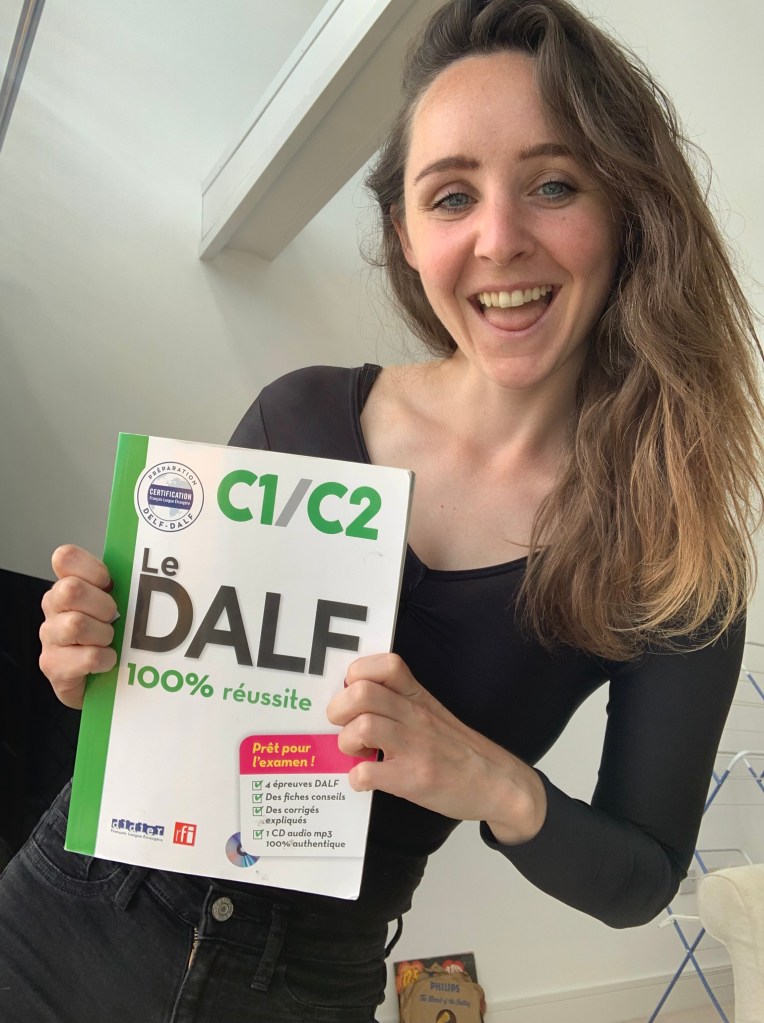
A few years passed without uttering a single French word (my excuse is that I was distracted in China) when I realised the dynamic between my French friends and I had changed. The inside jokes just weren’t as funny in English. This made me sad so I moved to Paris, pivoted my business with the mission of inspiring more Brits to learn languages, enrolled myself in the French C1 exam (& passed), and became a Franco-British Young Leader in the midst of it all.
So there we have it, almost 20 years of learning French. C2 is next, but that requires me to tidy up my grammar once and for all and vousvoie people which, since I am incapable of taking life seriously, doesn’t align with my ✨ vibe ✨. I digress. No language learning journeys are linear, they require a lifetime of love and commitment. Kind of like a marriage, I guess. Let’s dive into making your experience of learning French as unforgettable as possible. Allez ze barti.
HOW YOU CAN DO IT.
Learning a language requires a growth mindset. From, “I can’t do this” to “I can’t do this yet”. It requires grit, which psychologist Angela Duckworth frames as, “passion and purpose towards long-term goals”, and it also requires the recognition that improving by 1% every day leads to significant gains over time. It is a consistent and conscious effort, but above all, you have to make it fun for you.
Your motivation for learning French needs to be intrinsic; that’s to say you enjoy the process, have specific and achievable personal goals, and are driven to succeed for yourself, not others. When you integrate French into your current hobbies or passions, create a positive learning environment, have the choice of different resources to learn according to how you feel, and have opportunities to use French in real-life settings, that’s when things start to get spicy. 🌶
In addition, headspace is everything when it comes to absorbing a language. I say absorb, because creating (& internalising) an identity in your target language is one of the most life-changing things you can do. As a beginner, the best thing you can do is listen to sounds, watch how people communicate (facial expressions, gestures, how they laugh), sing their songs, cook their recipes and try to understand their humour etc. As you progress, fluency then starts to come more naturally.
SECRET 1: BE CLEAR ABOUT YOUR GOALS.
The Science of Micro-Wins & Identity Shift
- Shift from “learning French” to “becoming a French speaker.” Research on identity-based habits (James Clear, Atomic Habits) shows that when you view yourself as someone who speaks French rather than someone trying to learn French, your behavior follows suit.
- Micro-wins rewire your brain. The 1% Rule (Kaizen) and The Compound Effect (Darren Hardy) both show that tiny improvements daily create exponential progress. Learning just 1 new phrase a day is 365 phrases a year!
- Your brain loves clear targets. According to Edwin Locke’s Goal-Setting Theory, goals work best when they’re specific, challenging, and time-bound.
- ❌ “I want to learn French.”
- ✅ “By August, I will confidently order food in French, using full sentences.”
- Embrace Failure Tolerance. Polyglot Benny Lewis (Fluent in 3 Months) suggests aiming for “controlled struggle.” Meaning: if you never feel awkward speaking, you’re not pushing yourself enough. That’s where Private Joke ® with its giggles and creativity can be a real win for enhancing speaking confidence, but more on this here.
SECRET 2: KNOW HOW YOU LEARN.
Forget the Classroom. Hack Your Brain Instead.
- Your brain craves context, not rules. Traditional school methods drill grammar first, but cognitive linguists (Stephen Krashen’s Input Hypothesis) show that immersion and meaningful exposure beat memorization.
- Example: Instead of studying verb conjugations, watch a French Instagrammer talk about something you love (fashion, football, food).
- Dopamine fuels language retention. Studies in neuroplasticity (Dr. Andrew Huberman) reveal that when learning feels rewarding, our brain retains more.
- Hack: Pair French study with something enjoyable (e.g., learn while eating chocolate 🍫). Your brain will link French to pleasure.
- Leverage the Spacing Effect. Spaced repetition (used in apps like Anki) strengthens memory. Don’t cram; learn little and often.
- Don’t learn like a student. Learn like a toddler. Children don’t analyse grammar – they listen, copy, and experiment. Instead of obsessing over correctness, mimic and play:
- Talk to yourself in French while cooking 🍳.
- Develop a persona and let French bring out new parts of your personality.
- Assign objects a personality and make them “talk” (yes, talk to your chair 🪑).
SECRET 3: CREATE A PERSONA.
Alter Egos Unlock Fluency Faster.
- The “Beyoncé Effect.” When Beyoncé needs confidence, she channels Sasha Fierce.
- Example: If you’re shy in English, create a French alter ego who’s bold and flirty. Your persona allows you to speak without overthinking.
- Acting tricks for natural fluency. Research in cognitive psychology shows that mirroring native speakers (intonation, expressions, even posture) speeds up fluency. Try:
- Watching a scene from Lupin 🎭, then repeating it exactly like Omar Sy.
- Mimicking how French people shrug, pause, and say “bof.”
- Assign your persona a real life. The more details, the better:
- French name: Lucie? Antoine? Or just your name with a French accent.
- Backstory: “Lucie is an artist in Lyon who loves wine & philosophy.”
- Speech style: Does Lucie talk fast? Use lots of slang?
- Create a WhatsApp chat where you text AS your French self.
- Your French self = your fearless self. Many people fear making mistakes in a new language. For adult learners, this can be a particular challenge. But your persona doesn’t care! The best way to beat embarrassment?
- Be playful: Give your persona a funny accent.
- Be dramatic: Over-pronounce words like a French actor.
- Be rebellious: Intentionally use slang (or franglais) instead of textbook phrases.
🇫🇷 WORKSHEET: DESIGN YOUR FRENCH ROADMAP.
At first, it can feel overwhelming, but it doesn’t have to be. For best results, I recommend printing this worksheet, completing it by hand, and then keeping it somewhere visible (ideally in your French study place) while you progress through your French goals. I recommend re-doing monthly as your language skills improve. It might take anywhere from 30-45 minutes; it’s your call!
RESOURCES
Listening & Speaking
🔹 TOP TIPS (GENERAL) 🔹
- 🔹 Little & Often → Spaced Repetition Beats Cramming. Research in cognitive psychology (Ebbinghaus’ forgetting curve) shows that frequent, short bursts of practice are far more effective than cramming. Your brain needs to forget a little before relearning, and (shock) this strengthens retention. Instead of setting aside hours, integrate speaking into your daily life. Narrate actions (Je fais du café) and ask yourself questions (Qu’est-ce que je vais faire aujourd’hui ?).
- 🔹 Speaking Without Translating → The Mental Model Shift. Studies on second language acquisition (VanPatten, 2017) emphasize the importance of thinking in your target language instead of translating from English. One trick? Describe things with the words you already know. Instead of searching for fork, say l’outil pour manger une salade. Work with what you have as this builds fluency faster than memorising isolated vocabulary.
- 🔹 Tutoring with Delayed Correction → Real-Time Fixes Disrupt Fluency. A 2016 study by Lyster & Saito found that real-time grammar correction interrupts cognitive flow and reduces confidence. Instead, opt for a tutor who corrects you after you finish speaking, either via text or by revisiting mistakes naturally in conversation. (I used a tutor with italki for my French C1 and it worked wonderz). She would write down corrections while I spoke, then we’d reframe the topic and I’d implement the fixes. This technique dramatically boosts retention.
- 🔹 Immersion Works, But Only If You Resist English. Studies on language immersion (Dewey, 2017) show that just being in a country isn’t enough – active engagement is key. The trick? Pretend you don’t speak English. In shops, bars, and markets, lead with “Je veux pratiquer mon français.” If they reply in English, insist on French. For an adrenaline rush: go to a bar alone, get a little buzzed, and try flirting in French. Science supports this – alcohol temporarily lowers language anxiety (Cogo & Pizarro, 2019). *Under 18s, please don’t try this.
- 🔹 Mirroring: How Babies Learn Languag. Linguists (Flege, 1995) found that pronunciation improves fastest when learners imitate native speakers in real time. This is how infants acquire accents. I unknowingly perfected my Mandarin accent by mimicking Beijing taxi drivers. In French, copy newscasters, comedians, or TikTokers. Over-exaggerate and your brain will adjust naturally.
- 🔹 The “Conversational Load” Principle → Start Short, Build Up. Learners gain fluency faster by starting with short, structured conversations before tackling open-ended dialogue. Instead of diving into deep conversations right away, start with daily 5-minute calls with a tutor or language partner. Keep the topics predictable (e.g., describing your day). This keeps your cognitive load manageable and builds speaking confidence over time.
🎶 MUSIC RECOMMENDATIONS 🎶
- Angèle | Kind of like the Belgian Dua Lipa. Her song, “Balance Ton Quoi” is a play on “Balance ton porc” which translates as “expose your pig” and was a French social media movement similar to #MeToo, encouraging women to publicly call out sexual harassment.
- Aya Nakamura | Remember the French-Malian singer from the Paris Olympics? Aya is a great artist to introduce to beginners as she plays with French. Check out the hit with Stormzy, “Plus Jamais”
- Bonentendeur | A playlist of iconic hits blended with interview clips with famous French people. A great track to have on in the background during a dinner party and attune your ear.
- French Deep House | You’ll be wanting to turn this up, loud.
- Juniore | A Parisian trio blending 1960s psychedelia, surf music, and yé-yé. Their recent album “Trois, Deux, Un” showcases dreamy vintage sounds with tracks like “Déjà vu” and “Méditerranée”.
📺 NETFLIX (& PLUG-INS) 📺
Always use “Language Reactor”! I can do a separate article on this, but to begin with, you want the audio in French, and the subtitles in both English & French (through the plug-in, not on Netflix). Features include your own personalised dictionary.
- Plan Coeur | My all-time favourite Netflix series; I watched this a few months before moving to Paris in autumn 2022 and loved every second of it … the sororité, Elsa’s relatable clumsiness, the hilariousness of the plot. Very wholesome.
- Family Business | There are a few series of this now, so more than enough to sink into. It’s a comedy about a family who, trying to save their boucherie (butcher), end up growing marijuana instead. It gets progressively outrageous.
- Drôle | Very cute, romantic, and giggly; through facing their own struggles, two comedians from opposite sides of Paris clumsily fall in love.
- Super mâles| My latest obsession. This series had me in stitches with an exceptional performance from Guillaume Labbé (who I can only describe as a young, French Hugh Grant).
- Class Act | Fictionalising the story of serial French entrepreneur, Bernard Tapie, this series was invigorating, inspirational, and brilliant.
✨ LEARN VIA INSTAGRAM ✨
Ahh, scroll time. For me, scroll time is doom time. But if you’re smart about it, it doesn’t have to be. I recommend following a ton of French influencers (who are aligned with your interests & hobbies), as well as some more focused language learning accounts. Be intentional when you scoll; you could, for example, allow yourself 30 minutes of Frolling (French scrolling, obvs 🔥) time but with a notepad beside you so that you are writing down any new vocabulary.
- its_luns | My favourite up-and-coming French singer! Although her music is giving sad girl summer, her lyrics are very colloquial and romantic.
- street_french | Focuses on colloquial, spoken French. His “stop saying (…). In French” and instead say “(…).” posts are super useful. Bin everything you were taught in the classroom.
- tatty_macleod | Equally funny in both French and English, a very rare skill imho.
- ptcomedy | Another comedian and another human who appreciates the beautiful blend of both English and French mashed into one.
Reading & Writing
🔹 TOP TIPS (GENERAL) 🔹
- 🔹 “The Input Hypothesis” → Read Above Your Level (But Not Too Much) Linguist Stephen Krashen found that reading slightly beyond your current level (what he calls i+1) is key for growth. If it’s too easy, you won’t learn new structures. If it’s too hard, you’ll get frustrated. Tip: Read books with 90–95% known words so you can guess the rest from context.
- 🔹 The “Gap-Filling” Effect → Rewrite Without Looking. A study by Nation (2001) found that rewriting texts from memory (rather than copying) strengthens sentence structure and vocabulary retention. Try this: Read a passage, close the book, and rewrite it in your own words. Compare your version to the original and note differences.
- 🔹 Handwriting vs. Typing → The Pen is Mightier for Memory. Studies in cognitive neuroscience (Mueller & Oppenheimer, 2014) reveal that writing by hand builds deeper neural connections than typing. It forces you to slow down, process words, and engage with the language on a physical level.
- 🔹 “Translanguaging” → Write in a Mix of Your Native & Target Language. Rather than forcing yourself to write only in the target language, allow some words or phrases from your native tongue. Research (García & Wei, 2014) shows this bridges linguistic gaps and helps learners push through difficult concepts without losing fluency. This is basically the power of Franglais! ❤️
- 🔹 Use “Scripted Output” to Sound More Natural. Instead of only writing freely, copy native speaker sentences verbatim (shadow writing). This technique, backed by corpus linguistics (Bybee, 2006), helps internalize rhythms, collocations, and idiomatic structures. This is a great one to try with Netflix & the Language Reactor plug in, for example.
- 🔹 Keep a “Misuse Journal” → Learn from Your Own Mistakes. Instead of just memorising corrections, track your recurring writing mistakes. Studies (Ferris, 2006) show that self-awareness of errors helps learners avoid repeating them long-term. (This is another secret power of Private Joke ®, but more on this another time).
📌 VOCAB TOOLS 📌
- Anki / Quizlet | Uses spaced repetition, the gold standard for memorisation.
- Readlang | Click words while reading online to create instant flashcards.
- Flashcards | Write new words by hand, then review them weeks later (not immediately). This forces long-term recall, and it’ll send you into a bizarre 15yo nostalgia state writing out flashcards. Bonus Hack! Instead of memorising isolated words, learn collocations (words that naturally go together). E.g., instead of just learning “briser” (to break), learn “briser le silence” (break the silence).
- Learn the 500 Most Frequent Words | You can’t go wrong with just sitting down like an old-fashioned human being, and rote learning these words.
🎨 POETRY 🎨
- “Identity Poetry” → My Masters thesis looked at ways in which (bilingual) poetry can be used to help language learners express their linguistic identity. Getting creative with ways to express yourself as you “become” a French-speaker is a lot of fun.
- Poetry → The rhythm and repetition reinforce structures naturally. Try copying French poems and then rewriting them in your own words. If you are a beginner, write them in Franglais with French as the core, and English around the edges.
📚READING RESOURCES 📚
- 🗞 News in Slow French | Articles, clickable translations, grammar breakdowns, and slow audio.
- 🗞 RFI Savoirs | News articles with transcripts and exercises for learners.
- 🗞 Le Petit Journal | French expat news, clear writing style, and international news.
- ❤️ The Fable Cottage | Classic fairy tales in simple French with audio. Extremely, extremely wholesome and possibly my favourite thing ever.
- Anything by Olly Richards | Short Stories with French and English side by side – there is also a vocabulary list at the end. A good opportunity for no phone time!
 Olive Halsall
Leave a comment